Working Paper & Work in progress
Fintech Issues
Stablecoins, Your Solution (2026)
Forthcoming.
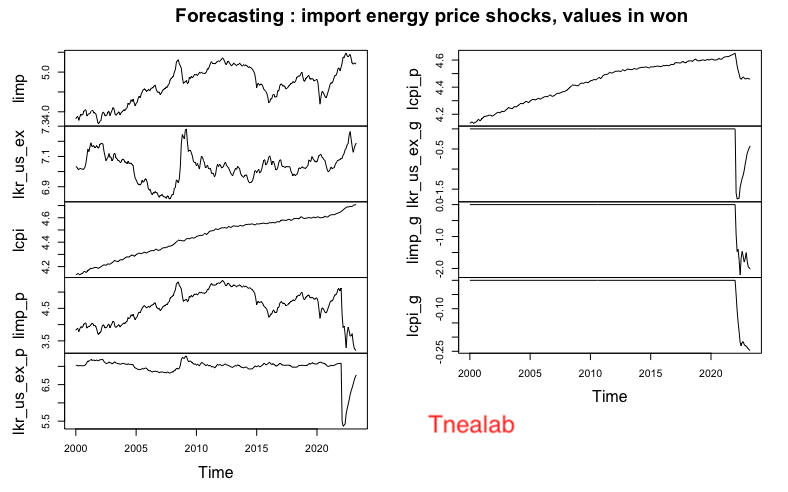
Note: _p denotes a prediction and _g indicates a gap between the in-sample data and forecasting one. The initial experiment model was highly sensitive to the scale of interventions.
Experiment Study1 : Big shocks and A variation of the Plaza Accord in the…... ( initiated in October 2022)
–Related policy discussion : G20 Global Financial Stability Conference 2022
Experiment Study 1: Big shocks and a Variation of the Plaza Accord in an Era of CBDCs (September, 2023, Sujin Kim, presented at the CBDC Workshop, city, University of London)
The ever-strengthening US dollar, coupled with soaring oil prices and the ongoing fiscal strains after the COVID-19 pandemic, drags policymakers into complex dilemmas. Recent unprecedented monetary policy shocks in the US remind us of the events of the 1980s, which led to the legacy of the Plaza Accord. It is indisputable that most resource-importing countries benefit from a stable and strong domestic currency to alleviate the pass-through of US dollar-denominated commodity price shocks to inflation. The call for improving the current international monetary system is on the rise. To frame the debate within a forward-looking context, this paper explores a sectoral fixed exchange rate approach, in a hypothetical use of CBDCs. Analyzing a monthly dataset of South Korea over the period 2000-2023 reveals two stable and positive long-run equilibrium associations among KRW-US dollar exchange rates, CPI and IPI (import price index) in energy related sectors. While the IPI inflation rates in invoicing currencies experience a brief drop to a depreciating FX shock, due to a decrease in the import quantity, the index measured in KRW significantly increases in response to the FX shock, with the quantity effect being overshadowed. In-sample forecasting results based on the models show that exchange rate interventions in a contract currency model reduce the energy IPI and CPI prices but exchange rates reverse to the depreciation trend. In a case of energy import price interventions in the domestic currency model, the import prices, CPI and exchange rates decline while the latter first substantially appreciated and rebounding to the trend. Alternative to the general intervention in the FX market, implementing the energy sector specific FX rates during a period of dollar-oil twin shocks would be more effective, preemptively abating fiscal burdens arising from oil tax cuts. How to design a CBDC is discussed.
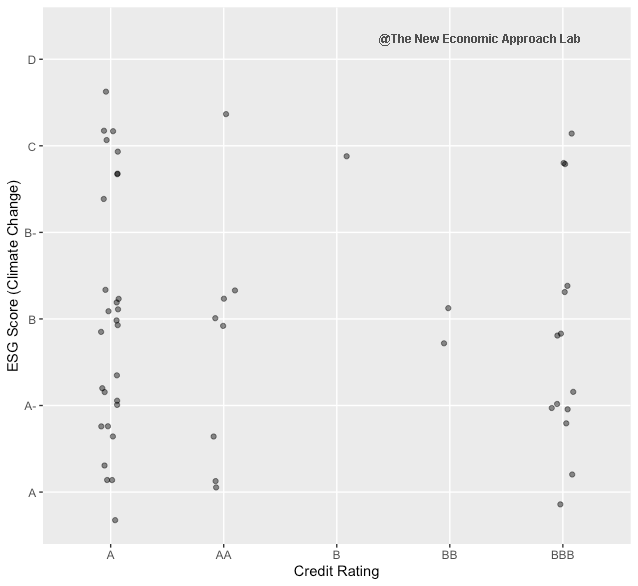
Credit Ratings vs CDP Scores (Climate Change)
Data source : Data from Cbonds and CDP
–Related policy discussion : Experts Opinions on the ECB's Green Agenda (the CFM Surveys)
Verweile doch, du bist so 'wirksam'!(?) : The Greening of Monetary Policy and Its Effects (December 2020, with T. Ehlers)
When Central Banks target green bonds as eligible assets for their open market operations, would it be an effective tool to manage climate risks via more ease access to green debt market? Focusing on euro-denominated green bond dataset from commercial financial data providers, this study evaluates the price and liquidity impacts of two main news releases and announcements by the European Central Bank (ECB). The first event we identify is the news interview with the president of the ECB in July 2020 on her strategic commitment to the ECB's green bonds purchase. The second one is an official announcement in September 2020 that the ECB will accept sustainability-linked bonds as collateral as well as eligible assets from January 1, 2021. We find that two news releases have substantially increased prices of the bonds on the ECB's list of eligible bonds and improved, at least marginally, the liquidity of the bonds. The yields of eligible bonds (bonds off the list) dropped in average by 25 bps (46 bps) after the first event and by 41 bps (66 bps) after the second. An interesting finding, compared to former studies, is that the group of non-eligible green bonds showed a sharper increase in post-event prices than the listed bonds. Bid-ask spreads also declined more in the former group. We assume that such positive spillover effects of the policy might be substantial in a type of less liquid debt market. In terms of carbon emission at the issuer level, not all high credit rates indicated a good ESG score and vice versa. A dual (credit and environmental) rating system could better meet the goal of green monetary policy.
Safe Asset Shortage Index
Coming soon.